Corporate Governance
Basic Stance on Corporate Governance
The Group values the spirit of its founding, and its “eternal philosophy” is the unwavering ambition to “brighten the world.” We consider contributing to improving the social value of the food service industry to be our “eternal mission.” Furthermore, our goal is to become a company that continues to thrive for generations, an “eternal company.” To this end, we aim to maximize corporate value through the formulation of management strategies and management decision-making, as well as through shared prosperity with shareholders, customers, business partners, employees, and society as a whole. We believe that compliance with corporate governance is crucial to achieving these goals.
We place the highest priority on fair and transparent management. In order to further strengthen corporate governance from various perspectives, we will continue to work on enhancing shareholder meetings, invigorating the Board of Directors, strengthening the auditing function of our auditors, and proactively disclosing information.
Corporate Governance Structure
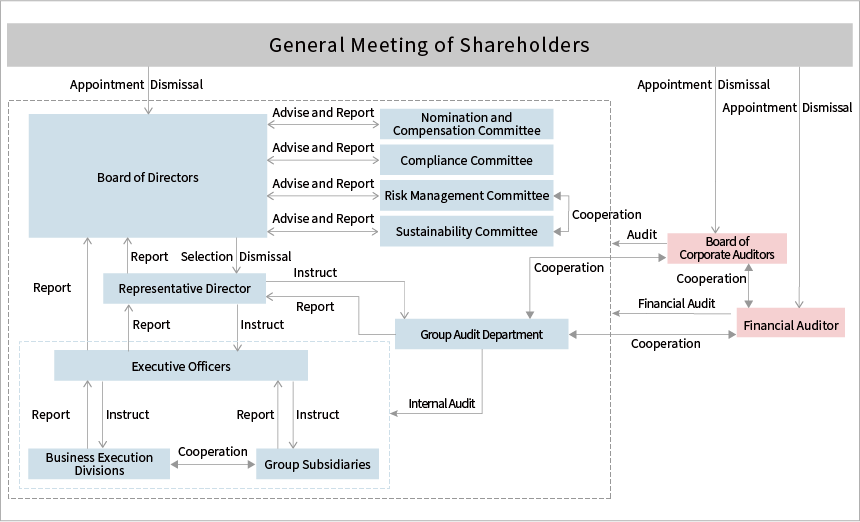
We have adopted the structure of a Company with a Board of Company Auditors, and are enhancing the management and supervisory functions over our business operations by appointing several highly independent outside corporate auditors and strengthening the functions of corporate auditors.
We have established a General Meeting of Shareholders, Board of Directors, and Board of Corporate Auditors as bodies required by the Companies Act, as well as a Nomination and Compensation Committee, Compliance Committee, Risk Management Committee, and Sustainability Committee in order to establish an internal governance structure. We adopted the current corporate governance structure because we believe that the mutual cooperation between these bodies will ensure the soundness, efficiency, and transparency of management.
Details regarding each of the Company’s bodies are as follows.
(Board of Directors)
The Company’s Board of Directors consists of two internal directors and three external directors, and is positioned and operated as the body responsible for formulating management policies, making business decisions, and supervising the execution of business through mutual checks and balances among the directors. The Board of Directors meets once a month in principle, and extraordinary meetings are held as necessary to expedite management decision-making. In addition, corporate auditors attend meetings of the Board of Directors to serve as a check on management.
(Board of Corporate Auditors)
The Board of Corporate Auditors consists of two full-time corporate auditors (Kazutoshi Araki [Chairman] and Masahiko Harada) and two outside corporate auditors (Minoru Hikita and Yoshihito Ishii), and meets once a month in principle.
Regarding audits by corporate auditors, in addition to exercising their legal rights, such as receiving reports from directors and employees, all corporate auditors attend the General Meeting of Shareholders and Board of Directors meetings. In order to engage in effective monitoring, full-time corporate auditors attend important management meetings as well as Risk Management Committee, Compliance Committee, and Sustainability Committee meetings, and conduct on-site inspections of each department. It is through these efforts that they monitor the state of governance and its operation and audit day-to-day activities, including the execution of duties by directors.
Outside auditors are certified public accountants and lawyers, and they conduct management oversight from a perspective of professional ethics.
(Nomination and Compensation Committee)
The Nomination and Compensation Committee was established to enhance corporate governance by strengthening the independence and objectivity of the Board of Directors’ functions related to director nominations and compensation. The committee serves as a voluntary advisory body to the Board of Directors and has the authority to deliberate on and make recommendations to the Board of Directors regarding director nominations, compensation, and other matters in response to inquiries from the Board of Directors. The committee consists of three or more directors selected by resolution of the Board of Directors, a majority of whom are independent outside directors. In addition, by having an outside director as the chairperson, transparency and objectivity of deliberations are ensured, and the independence of the committee is strengthened.
The composition of the committee is as follows.
Chairperson: Saki Igawa, Outside Director
Committee Member: Kae Nagaoka, Outside Director
Committee Member: Ryuji Nakatake, Outside Director
Committee Member: Tadashi Okura, Representative Director
(Compliance Committee)
The Compliance Committee is composed of members from across the organization and meets in principle once every three months. In addition to establishing education and training systems for officers and employees, they promote various initiatives to deepen understanding of various laws and regulations, including the Food Sanitation Act, the Financial Instruments and Exchange Act, and the Companies Act, and to raise compliance awareness among all employees.
(Risk Management Committee)
The Risk Management Committee is responsible for the company-wide promotion of risk management and conducts a wide range of activities, including providing and sharing information necessary for risk management. It also provides advice and guidance on risk management training and other internal awareness-raising activities, supporting the raising of awareness and deepening of initiatives throughout the organization.
(Sustainability Committee)
This committee is composed of an executive officer of the Company, who acts as chairperson, and business officers, with the Corporate Planning Office as the overseeing department. It is responsible for formulating basic policies regarding sustainability, identifying key issues (materialities), and considering target indicators of the Group.
The Company’s organization, management system, and internal control structure are as follows.