
Disclosure Based On TCFD Recommendations
The Group recognizes the importance of the risks and opportunities associated with climate change as we continue to expand our business and realize our vision. Based on the recommendations of the TCFD (Task Force on Climate-related Financial Disclosure), we will gradually promote the disclosure of information in four areas; Governance, Strategy, Risk Management, and Indicators and Targets, in order to improve corporate transparency and sustainability.
Governance
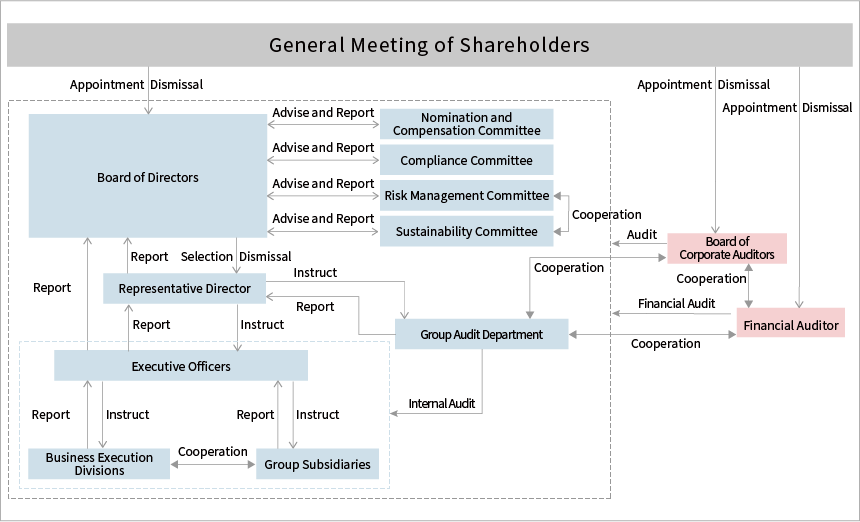
In order to promote our basic policies and key issues related to sustainability, including climate change, in an integrated manner with our management strategies, we have established a governance structure centered on oversight by the Board of Directors and management by the Sustainability Committee.
The Sustainability Committee is responsible for examining medium- and long-term issues, formulating policies, considering measures to address risks and opportunities regarding climate change, and developing indicators and targets. The Board of Directors receives reports on these results from the Sustainability Committee at least once a year, monitors them, and makes decisions on necessary matters. The Representative Director, President, and CEO, as the individual in charge of business execution, directs and promotes the execution of sustainability-related operations, maintaining an understanding of the expectations of investors not only through reports and recommendations from the Sustainability Committee, but also through responses to CDP questionnaires and IR activities.
Strategy
Scenario Analysis for Climate Change
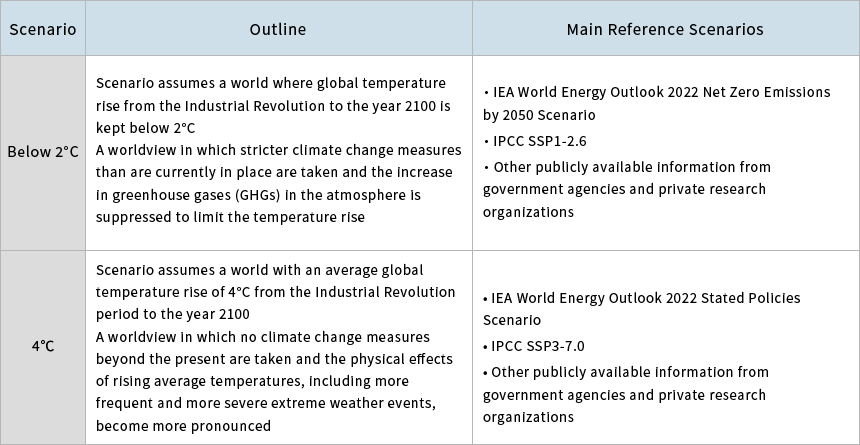
The Group uses two scenarios of an increase in future temperatures: the under 2°C scenario, in which the impacts associated with the transition to a low-carbon society are more pronounced, and the 4°C scenario, in which the physical impacts associated with climate change are more pronounced. In analyzing the scenarios, we primarily focused on Torikizoku, as it is the core business of the Group. The short-term timeframe is through FY2026, the end of the next medium-term management plan, while the medium-term and long-term timeframes are through FY2030 and FY2050, respectively, taking into account the targets set by the Japanese government.
Under 2°C Scenario
The introduction of a carbon tax and carbon pricing is expected to increase food procurement and store operation costs, which will affect the Group’s profits. In addition, if GHG emission regulations are tightened in various countries, we may be forced to respond to such regulations when entering such regions or to replace equipment in existing stores, which may lead to increased costs. On the other hand, as society becomes more environmentally conscious, we assume that we will have an opportunity to maintain and improve our reputation with our stakeholders, including customers, employees, shareholders/investors, business partners, and society, by continuing our efforts to address climate change and disclose non-financial information.
4°C Scenario
In addition to the loss of opportunities due to extreme weather conditions and the expected cost of restoring damaged store facilities, we anticipate that the procurement of key raw materials may also be impacted. On the other hand, environmental awareness in society will remain the same, so opportunities such as those in the under 2°C scenario are likely to be limited.
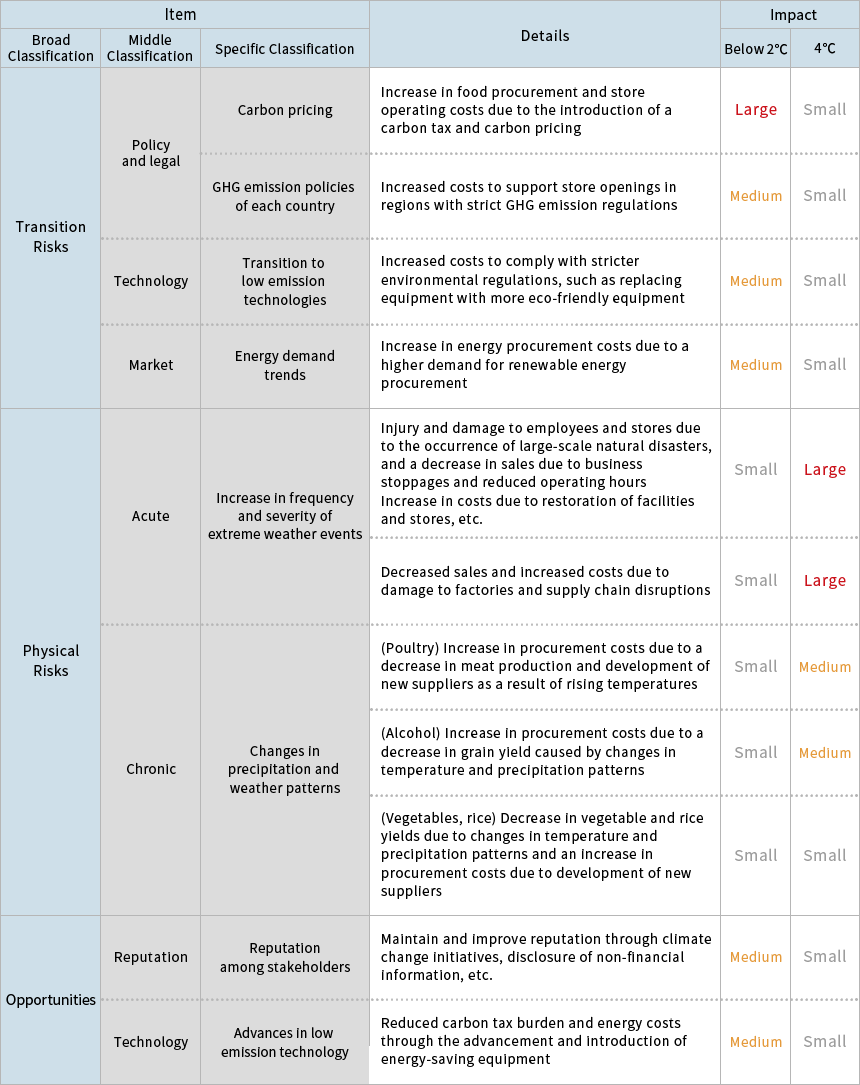
Based on the above scenario analysis, the most significant impact for the Group would be the introduction of carbon pricing (under 2°C) and more frequent and severe extreme weather events (4°C). The Group will work to reduce CO2 emissions, collaborate with suppliers, and seek measures that take into account physical risks, as well as engage in ongoing discussions and update information.
Risk Management
For climate-related risks, the Sustainability Committee, with the Corporate Planning Office as the supervising department, takes the lead in identifying and assessing risks and opportunities through scenario analysis. These results are shared with the Risk Management Committee, integrating climate-related risks into the Group’s overall risk management system. The two committees work together organically and effectively through regular information sharing and consultation.
Indicators and Targets
CO2 emissions (Scope 1 and Scope 2*) for Japan from FY2022 to FY2024 as currently understood by the Group, as well as the emissions intensity divided by net sales, are as follows.
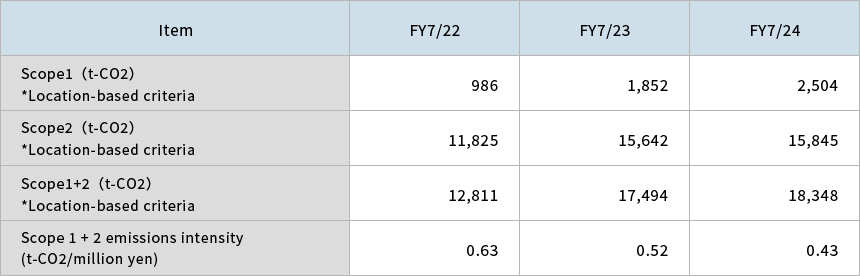
We will continue to examine and conduct factual surveys in order to set targets and grasp Scope 3 emissions.
*Location-based criteria are used.